.gif)
Description
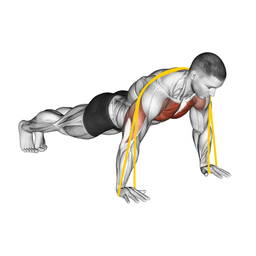
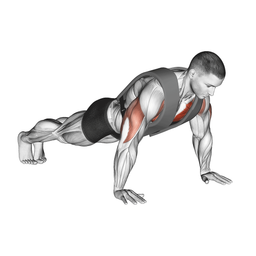
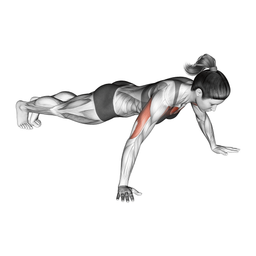
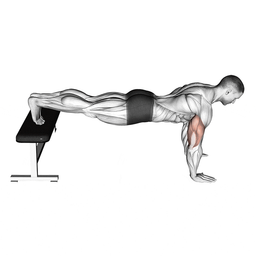
The Push Up is a classic bodyweight exercise and a fundamental upper body movement. It simultaneously targets the pectoralis major, triceps, anterior deltoids, and core muscles. Requiring no equipment, it can be performed anywhere—at home, in the park, at the office, or while traveling. It is suitable for everyone from beginners to advanced athletes, and the difficulty can be increased through various variations. It is also highly effective for developing functional strength, endurance, and posture. It serves as a foundational movement in a wide range of disciplines, from military training and boxing workouts to calisthenics and general conditioning programs. When performed regularly, it provides significant improvements in upper body strength, chest development, core stabilization, and overall conditioning. Range of motion and technical proficiency will improve over time.
Push Up How-To Guide
- 1
Lie face down on the floor and place your hands slightly wider than shoulder-width apart.
- 2
Your palms should be flat on the floor with your fingers pointing forward.
- 3
Push your body off the floor, balancing on your toes.
- 4
Keep your body in a straight line from head to heels (plank position).
- 5
Engage your core muscles; do not let your lower back sag or your hips rise.
- 6
Lower yourself in a controlled manner by bending your elbows.
- 7
Descend until your chest is close to the floor, keeping your elbows flared at a 45-degree angle.
- 8
Push back up by squeezing your chest and triceps muscles.
- 9
At the top position, your arms should reach full extension but avoid locking out the elbows.
Key Points
- ✓Hands should be slightly wider than shoulder-width apart.
- ✓The body must form a straight line from head to heels.
- ✓Elbows should be tucked at a 45-degree angle (not flared straight out).
- ✓The core must be kept tight at all times.
- ✓Use a full range of motion.
Common Mistakes
- ✗Sagging the hips - indicates poor core control.
- ✗Piking the hips upward - breaks the form.
- ✗Inadequate range of motion - prevents full muscle engagement.
- ✗Flaring the elbows out completely - puts excessive strain on the shoulders.
- ✗Dropping the head forward - strains the neck.
- ✗Performing the movement too fast - leads to a loss of control.
Breathing
Inhale as you lower your body, and exhale as you push back up.
Muscle Activation
Safety
Precautions
- Individuals with acute wrist injuries should exercise caution.
- Individuals with acute shoulder injuries must pay strict attention to form control.
Safety Tips
- Start with kneeling push-ups first (for beginners).
- Perform on a soft surface or mat.
- Warm up your wrists beforehand.
- Stop the exercise when your form breaks down.
- Keep your neck neutral; avoid dropping your head.
Frequently Asked Questions
Which muscles does Push Up work?
Push Up primarily works these muscles: Göğüs, Alt Göğüs. It also engages: Triceps, Ön Omuz, Core kasları.
Is Push Up suitable for beginners?
Push Up is a Beginner level exercise. Learning difficulty: Easy.
Can Push Up be done at home?
Yes, Push Up can easily be done at home.
What are common mistakes when doing Push Up?
One of the most common mistakes: Sagging the hips - indicates poor core control.
How many sets and reps for Push Up?
Recommended: 3-4 sets and 10-25 reps.
- ✓A fundamental upper body compound movement.
- ✓Simultaneously works the chest, triceps, and shoulder muscles.
- ✓Improves core stabilization.
- ✓Requires no equipment and can be done anywhere.
- ✓Improves posture.
- ✓Builds functional strength and endurance.
- ✓Has countless variations and can be adapted to any fitness level.