.gif)
Description
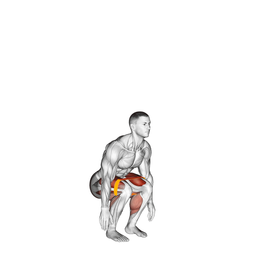
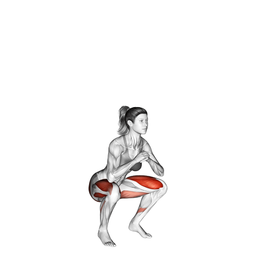
Stability Ball Wall Sit is an isometric leg exercise performed with a pilates ball against a wall. This movement statically works the quadriceps muscles while also placing secondary load on the gluteus and hamstring muscles. Using a stability ball increases back comfort and provides a natural sliding surface during the movement. It is commonly used for knee rehabilitation, increasing endurance, and developing muscle tone. With minimal equipment requirements, it is ideal for home workouts. It is a safe lower body strengthening option for beginners and individuals with knee problems.
Stability Ball Wall Sit How-To Guide
- 1
Place the stability ball at your lower back and lean against the wall, pressing the ball to the wall with your back
- 2
Position your feet shoulder-width apart, one step forward, with toes slightly turned outward
- 3
Keeping your back against the ball, slowly slide down until your knees reach a 90-degree angle
- 4
Hold this position for the designated time, keeping your quadriceps muscles tight
- 5
When time is up, slowly slide back up to the starting position
- 6
Ensure your knees don't go past your toes and your back stays against the ball
Key Points
- ✓Place ball between lower back and wall, position feet forward
- ✓Knees should be at 90 degrees, slide controlled on the ball
- ✓Lean back against ball, maintain balance between ball and wall
- ✓Work quadriceps muscles isometrically, hold position
- ✓Keep chest upright, hands should be at sides or chest
Common Mistakes
- ✗Placing ball too high or low - target angle not achieved
- ✗Letting knees go past toes - excessive load on knee joint
- ✗Holding for too short - muscular endurance doesn't develop
- ✗Allowing ball to slip - balance and stability lost
Breathing
Breathe normally and regularly, don't hold your breath. Keep muscles oxygenated with deep and rhythmic breathing.
Muscle Activation
Safety
Precautions
- Those with severe knee osteoarthritis should be careful
- Those with balance problems should use support
- Hypertension patients should limit duration
- Pregnant women should be careful in final trimester
Safety Tips
- Fully position ball against wall
- Don't exceed 90 degrees with your knees
- Gradually increase your duration
- Be cautious of possible ball burst
Frequently Asked Questions
Which muscles does Stability Ball Wall Sit work?
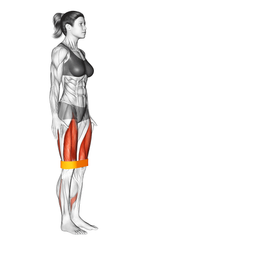
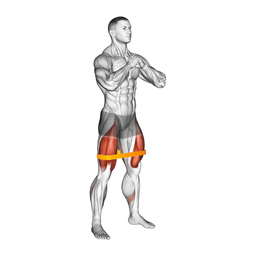
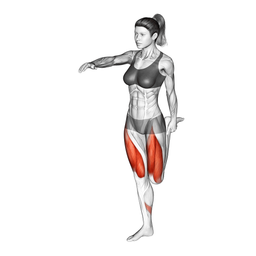
Stability Ball Wall Sit primarily works these muscles: Quadriceps. It also engages: Glutes, Core.
Is Stability Ball Wall Sit suitable for beginners?
Stability Ball Wall Sit is a Beginner level exercise. Learning difficulty: Easy.
Can Stability Ball Wall Sit be done at home?
Yes, Stability Ball Wall Sit can easily be done at home.
What are common mistakes when doing Stability Ball Wall Sit?
One of the most common mistakes: Placing ball too high or low - target angle not achieved
How many sets and reps for Stability Ball Wall Sit?
Recommended: 2-3 sets and 30-60 sec hold reps.
- ✓Develops isometric endurance in quadriceps muscles
- ✓Increases knee joint stability
- ✓Suitable for rehabilitation and beginner level
- ✓Strengthens core and lower body muscular endurance