.gif)
Description
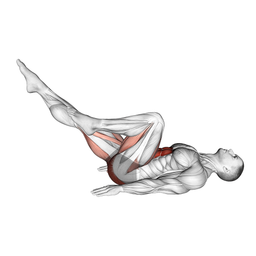
Reverse Crunches is an effective core exercise that targets the lower abdominal muscles. Unlike standard crunches, in this exercise the upper body is kept stationary and the hip region is moved. It works the lower portion of the rectus abdominis muscle in isolation and helps shape the lower abdominal area. It can be safer than standard crunches for those experiencing lower back pain. It requires no extra equipment and can be performed by athletes of all levels. When performed with proper form, it increases core stability and strengthens the abdominal muscles.
Reverse Crunches How-To Guide
- 1
Lie on your back, hands in a fixed position beside or under your body
- 2
Raise your legs in the air and bend your knees to 90 degrees, thighs perpendicular to the floor
- 3
Lift your hips off the floor by contracting your abdominal muscles and bring your knees toward your chest
- 4
Move only the hip region without lifting your upper back off the floor
- 5
Return to the starting position in a controlled manner, do not let your legs touch the floor
- 6
Avoid momentum throughout the movement and keep your abdominal muscles constantly contracted
Key Points
- ✓Lie on your back, place your hands beside your body or hold onto the edge of a bench
- ✓Lift your hips off the floor while keeping your knees bent at 90 degrees
- ✓Perform the movement by contracting your lower abdominal muscles, do not use leg momentum
- ✓Pull your knees toward your chest as you lift your hips upward
- ✓As you lower down, proceed to the next repetition before your feet fully touch the floor
Common Mistakes
- ✗Gaining momentum by swinging the legs - lower abdominal muscles do not work sufficiently
- ✗Lifting and straining the neck off the floor - causes unnecessary tension in the neck region
- ✗Not lifting the hips sufficiently off the floor - only leg flexion occurs, abdominal muscles are not activated
- ✗Performing the movement too quickly - control is lost and muscle development decreases
- ✗Over-arching the lower back - can lead to pain in the lower back region
Breathing
Exhale when lifting your hips and pulling your knees to your chest, inhale when returning to the starting position in a controlled manner.
Muscle Activation
Safety
Precautions
- Those with lower back pain should be careful
- Those with neck injuries should support their head
- Those with spinal problems should try a lighter version
- Should be avoided by pregnant women in the last trimester
Safety Tips
- Keep the back fixed to the floor, do not arch it
- Do not strain the neck, use hands only for support
- Perform the movement with abdominal muscles, not with momentum
- Lower down in a controlled manner
Frequently Asked Questions
Which muscles does Reverse Crunches work?
Reverse Crunches primarily works these muscles: Lower abs. It also engages: Hip flexors, Obliques.
Is Reverse Crunches suitable for beginners?
Reverse Crunches is a Beginner level exercise. Learning difficulty: Easy.
Can Reverse Crunches be done at home?
Yes, Reverse Crunches can easily be done at home.
What are common mistakes when doing Reverse Crunches?
One of the most common mistakes: Gaining momentum by swinging the legs - lower abdominal muscles do not work sufficiently
How many sets and reps for Reverse Crunches?
Recommended: 3-4 sets and 12-15 reps.
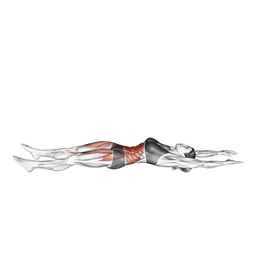
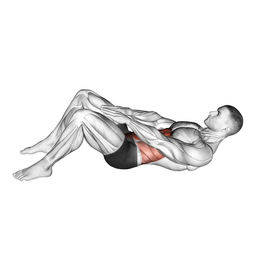
- ✓Targets the lower abdominal muscles
- ✓Provides an alternative variation to standard crunches
- ✓Shapes the core area
- ✓Provides a lower back-friendly abdominal exercise