BifitBifit
HomeExercisesBecome a Coach
Log In
HOMEEXERCISESBECOME A COACHLOG IN

Language

Legal

Terms of UsePrivacy PolicyDelete Account
BifitBifit

A modern and user-friendly mobile app that makes life easier for fitness enthusiasts. Tracking your workouts and progress is our priority.

Quick Links

  • Home
  • Exercises
  • Become a Coach
  • Download · Google Play
  • Download · App Store

Legal

  • Privacy Policy
  • Terms of Use
  • Support
  • Account Deletion

© 2026 Bifit. All rights reserved.

Designed for a healthy lifestyle

HomeExercisesHeel Elevated Squat

Heel Elevated Squat

Legs
Quads
Intermediate
Compound
3-4Set
8-12Reps
75sRest
3-1-2-0Tempo
Heel Elevated Squat
Animation

Description

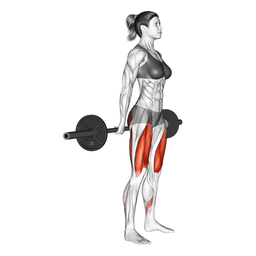
The Heel Elevated Squat is a squat variation performed by elevating the heels 2-5 cm, specifically designed to maximally target the quadriceps. Elevation is achieved by placing plates, a wedge, or using squat shoes under the heels. This height eliminates ankle mobility limitations and allows for a deeper squat. As a result, the torso remains upright, the glutes and hamstrings are less involved, and the load is shifted entirely onto the quadriceps. It is frequently used by bodybuilders to enhance quad detail and emphasize the teardrop muscle (vastus medialis). It also improves knee stability and strengthens the muscles surrounding the knee. It can be performed with bodyweight, dumbbells, or a barbell. When done regularly, it provides significant improvements in anterior thigh hypertrophy, quadriceps definition, and squat depth.

Step-by-Step Instructions

  1. 1

    Place a weight plate (2.5-5 kg), a wedge, or wear squat shoes under your heels.

  2. 2

    Position your feet shoulder-width apart or slightly narrower, with your toes pointing forward.

  3. 3

    Start with your bodyweight, or load the movement using dumbbells or a barbell.

  4. 4

    Depending on the load, extend your arms in front of you or position the bar on your shoulders.

  5. 5

    Brace your core, keep your back straight, and keep your chest up.

  6. 6

    Lower yourself in a controlled manner by pushing your hips back and bending your knees.

  7. 7

    Squat deep until your thighs are parallel to the floor or lower, keeping your torso upright.

  8. 8

    Allow your knees to track forward; they may pass your toes (this is safe due to the heel elevation).

  9. 9

    Push powerfully through your heels and squeeze your quadriceps to stand back up.

  10. 10

    Bring your knees to full extension at the top position.

  11. 11

    Keep your heels on the wedge/plate throughout the entire movement.

Key Points

  • ✓Heels should be elevated 2-5 cm (using plates, a wedge, or squat shoes).
  • ✓Feet should be positioned shoulder-width apart or slightly narrower.
  • ✓Maintain an upright torso position throughout the movement.
  • ✓Knees should track forward to allow for a deep squat.
  • ✓Squat deep (full ROM) to fully engage the quadriceps.
  • ✓Drive through your heels to stand up.

Common Mistakes

  • ✗Leaning the torso too far forward - breaks quadriceps isolation and engages the glutes.
  • ✗Letting the knees cave inward - creates joint stress.
  • ✗Insufficient range of motion - prevents full quadriceps engagement.
  • ✗Inadequate or excessive heel height - affects balance.
  • ✗Lifting the heels off the wedge - compromises the movement.
  • ✗Breaking form with too much weight - can lead to a loss of balance.

Breathing

Inhale and brace your core as you lower down, exhale as you stand back up.

Muscle Activation

quads0%
vastus medialis0%
rectus femoris0%
core0%
glutes0%
calves0%

Safety

Precautions

  • Individuals with acute knee injuries or chondromalacia should exercise caution.
  • Those with patellar tendon issues should limit the range of motion.
  • Individuals with acute lower back pain must pay close attention to form control.
  • Those with balance issues should perform the exercise with support.

Safety Tips

  • Practice your form with bodyweight first.
  • Adjust the heel height according to your flexibility.
  • Use a sturdy wedge/plate; it must be completely stable.
  • Limit the range of motion if you experience knee pain.
  • Check your knee alignment by looking in a mirror.
  • Squat shoes are ideal for long-term use.

Frequently Asked Questions

Which muscles does Heel Elevated Squat work?

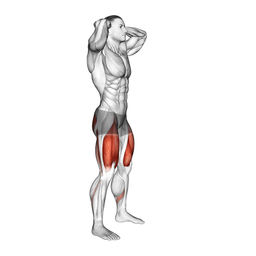
Heel Elevated Squat primarily works these muscles: Quadriceps, Vastus medialis. It also engages: Rectus femoris, Gluteus maximus, Core kasları, Kalf.

Is Heel Elevated Squat suitable for beginners?

Heel Elevated Squat is a Intermediate level exercise. Learning difficulty: Moderate.

Can Heel Elevated Squat be done at home?

Yes, Heel Elevated Squat can easily be done at home.

What are common mistakes when doing Heel Elevated Squat?

One of the most common mistakes: Leaning the torso too far forward - breaks quadriceps isolation and engages the glutes.

How many sets and reps for Heel Elevated Squat?

Recommended: 3-4 sets and 8-12 reps.
Related Exercises

Exercises targeting similar muscle groups

Legs Exercises
Dumbbell Goblet Curtsey Lunge

Dumbbell Goblet Curtsey Lunge

Quads

Belt Squat

Belt Squat

Quads

Smith Machine Squat

Smith Machine Squat

Quads

Hack Squat Musculature

Hack Squat Musculature

Quads

Reverse Hack Squat

Reverse Hack Squat

Hamstrings

Bodyweight Lunge

Bodyweight Lunge

Quads

Exercise Information

DifficultyIntermediate
Movement TypeCompound
FocusHypertrophy
Injury RiskLow
Set3-4
Reps8-12
Rest75 seconds
Tempo3-1-2-0
Spotter RequiredNo
Home / Gym
YesYes
Effectiveness4.3 / 5
Popularity7.0 / 10
Learning DifficultyModerate

Equipment

platebodyweightdumbbell

Primary Muscles

QuadricepsVastus medialis

Secondary Muscles

Rectus femorisGluteus maximusCore kaslarıKalf

Benefits

  • ✓Maximally activates the quadriceps in an isolated manner.
  • ✓Ideal for developing the vastus medialis (VMO).
  • ✓Enhances quadriceps detail and defines the teardrop muscle.
  • ✓Eliminates ankle mobility limitations.
  • ✓Improves knee stability (by strengthening the VMO).
  • ✓Increases squat depth.
  • ✓Promotes an upright torso position, protecting the lower back.
  • ✓Serves as a detail-oriented exercise for bodybuilders.

Goals

Muscle GainStrength
Back to All Exercises
Heel Elevated Squat
Animation

Description

The Heel Elevated Squat is a squat variation performed by elevating the heels 2-5 cm, specifically designed to maximally target the quadriceps. Elevation is achieved by placing plates, a wedge, or using squat shoes under the heels. This height eliminates ankle mobility limitations and allows for a deeper squat. As a result, the torso remains upright, the glutes and hamstrings are less involved, and the load is shifted entirely onto the quadriceps. It is frequently used by bodybuilders to enhance quad detail and emphasize the teardrop muscle (vastus medialis). It also improves knee stability and strengthens the muscles surrounding the knee. It can be performed with bodyweight, dumbbells, or a barbell. When done regularly, it provides significant improvements in anterior thigh hypertrophy, quadriceps definition, and squat depth.

Step-by-Step Instructions

  1. 1

    Place a weight plate (2.5-5 kg), a wedge, or wear squat shoes under your heels.

  2. 2

    Position your feet shoulder-width apart or slightly narrower, with your toes pointing forward.

  3. 3

    Start with your bodyweight, or load the movement using dumbbells or a barbell.

  4. 4

    Depending on the load, extend your arms in front of you or position the bar on your shoulders.

  5. 5

    Brace your core, keep your back straight, and keep your chest up.

  6. 6

    Lower yourself in a controlled manner by pushing your hips back and bending your knees.

  7. 7

    Squat deep until your thighs are parallel to the floor or lower, keeping your torso upright.

  8. 8

    Allow your knees to track forward; they may pass your toes (this is safe due to the heel elevation).

  9. 9

    Push powerfully through your heels and squeeze your quadriceps to stand back up.

  10. 10

    Bring your knees to full extension at the top position.

  11. 11

    Keep your heels on the wedge/plate throughout the entire movement.

Key Points

  • ✓Heels should be elevated 2-5 cm (using plates, a wedge, or squat shoes).
  • ✓Feet should be positioned shoulder-width apart or slightly narrower.
  • ✓Maintain an upright torso position throughout the movement.
  • ✓Knees should track forward to allow for a deep squat.
  • ✓Squat deep (full ROM) to fully engage the quadriceps.
  • ✓Drive through your heels to stand up.

Common Mistakes

  • ✗Leaning the torso too far forward - breaks quadriceps isolation and engages the glutes.
  • ✗Letting the knees cave inward - creates joint stress.
  • ✗Insufficient range of motion - prevents full quadriceps engagement.
  • ✗Inadequate or excessive heel height - affects balance.
  • ✗Lifting the heels off the wedge - compromises the movement.
  • ✗Breaking form with too much weight - can lead to a loss of balance.

Breathing

Inhale and brace your core as you lower down, exhale as you stand back up.

Back to All Exercises

Related Exercises

Exercises targeting similar muscle groups

Legs Exercises
Dumbbell Goblet Curtsey Lunge

Dumbbell Goblet Curtsey Lunge

Quads

Belt Squat

Belt Squat

Quads

Smith Machine Squat

Smith Machine Squat

Quads

Hack Squat Musculature

Hack Squat Musculature

Quads

Reverse Hack Squat

Reverse Hack Squat

Hamstrings

Bodyweight Lunge

Bodyweight Lunge

Quads