.gif)
Açıklama
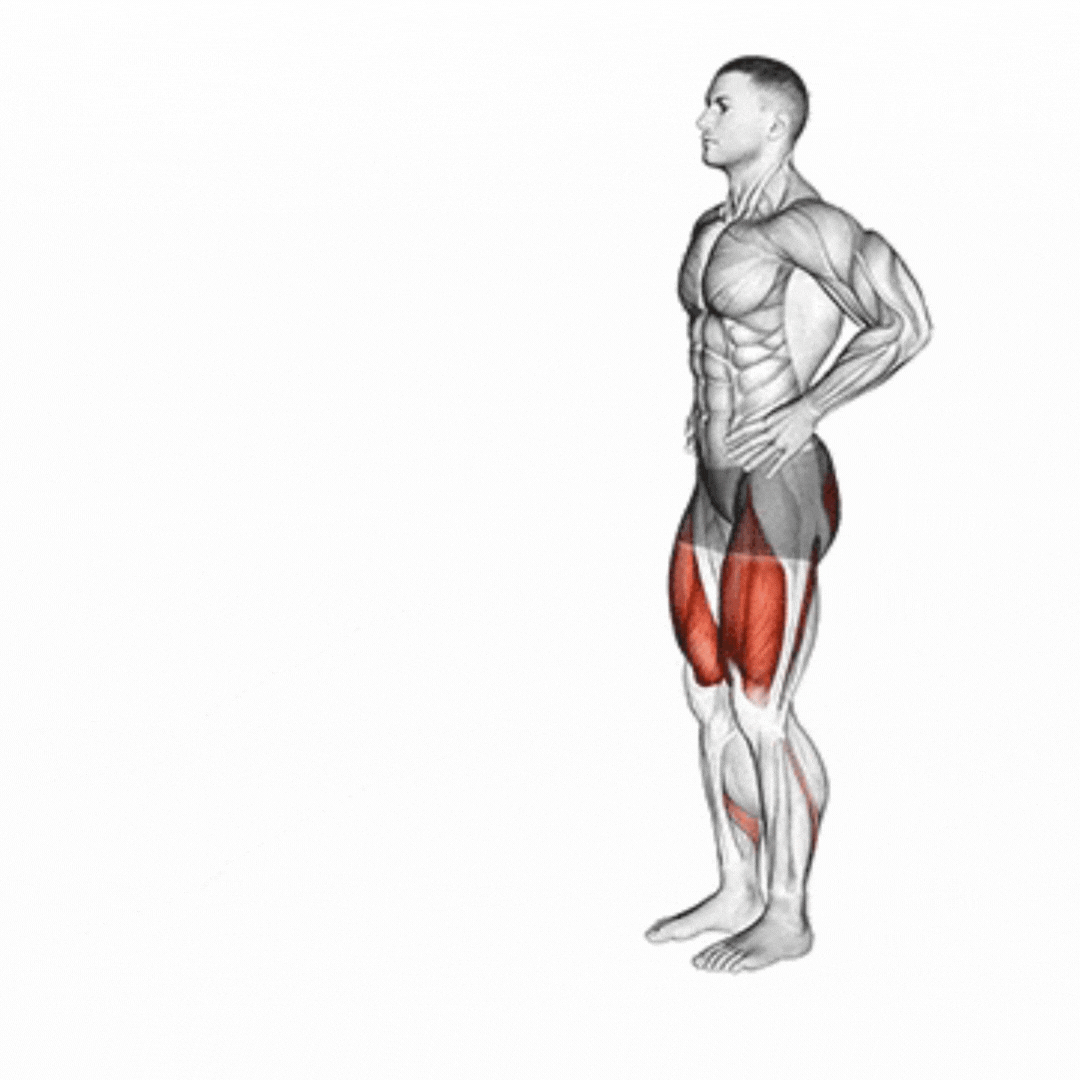
The Cyclist Squat is a specialized squat variation where the feet are placed narrower than hip-width apart and the heels are slightly elevated, aiming to maximally target the quadriceps. Its name comes from the cycling pedal position, and it intensely activates the vastus medialis (inner thigh) and rectus femoris muscles. Elevating the heels eliminates ankle mobility limitations and allows for a deeper squat. This keeps the torso upright, disengages the glutes and hamstrings, and places the load entirely on the quadriceps. It is frequently used by bodybuilders to enhance quad detail and define the teardrop muscle. It can be performed with bodyweight or loaded with a barbell or dumbbells. When done regularly, it provides significant improvements in anterior leg hypertrophy and quadriceps definition.
Adım Adım Talimatlar
- 1
Place a wedge, weight plate, or a 1-2 inch (2.5-5 cm) support under your heels.
- 2
Position your feet slightly narrower than hip-width apart, with your toes pointing forward.
- 3
Start with your bodyweight or load the movement with a barbell/dumbbells.
- 4
Extend your arms in front of you for balance, or rest the barbell on your shoulders.
- 5
Brace your core, keep your back straight, and keep your chest up.
- 6
Lower yourself in a controlled manner by driving your knees forward, keeping your torso upright.
- 7
Descend until your thighs are parallel to the floor or lower, performing a deep squat.
- 8
Push through your heels and squeeze your quadriceps to stand back up.
- 9
Bring your knees to full extension at the top position, but do not lock them out.
- 10
Keep your heels on the wedge or plates throughout the entire movement.
Önemli Noktalar
- ✓Heels should be elevated 1-2 inches (with a plate or wedge).
- ✓Feet should be hip-width apart, with toes pointing forward.
- ✓Maintain an upright torso position throughout the movement.
- ✓Knees should travel forward and can pass the toes.
- ✓The squat should be deep (full ROM) to fully engage the quadriceps.
- ✓Push up through your heels to rise.
Yaygın Hatalar
- ✗Leaning the torso forward - engages the glutes and ruins quadriceps isolation.
- ✗Letting the knees cave in - creates joint stress.
- ✗Inadequate range of motion - fails to fully engage the quadriceps.
- ✗Insufficient heel elevation - strains ankle mobility.
- ✗Breaking form with too much weight - can cause a loss of balance.
- ✗Lifting the heels off the wedge - compromises the movement.
Nefes Kontrolü
Inhale and brace your core as you lower down, exhale as you stand back up.
Kas Aktivasyonu
Güvenlik
Dikkat Edilmesi Gerekenler
- Those with acute knee injuries or chondromalacia should be cautious.
- Individuals with patellar tendon issues should limit the range of motion.
- Those with acute lower back pain must pay strict attention to form control.
- People with balance issues should perform the movement with support.
Güvenlik İpuçları
- Practice the form with bodyweight first.
- Adjust the heel elevation according to your flexibility.
- Perform on a soft mat.
- Limit the range of motion if you feel knee pain.
- Check your knee alignment by looking in a mirror.
- Stop the exercise if your form breaks down.
İlgili Egzersizler
Benzer kas grubunu çalıştıran egzersizler
Egzersiz Bilgisi
Ekipman
Birincil Kaslar
İkincil Kaslar
Faydalar
- ✓Maximally activates the quadriceps in an isolated manner.
- ✓Ideal for vastus medialis (VMO) development.
- ✓Enhances quadriceps detail and defines the teardrop muscle.
- ✓Eliminates ankle mobility limitations.
- ✓Increases knee stability (through VMO strengthening).
- ✓Requires no equipment and can easily be done at home.
- ✓Increases squat depth.
- ✓Serves as detail work for bodybuilders.