.gif)
Açıklama
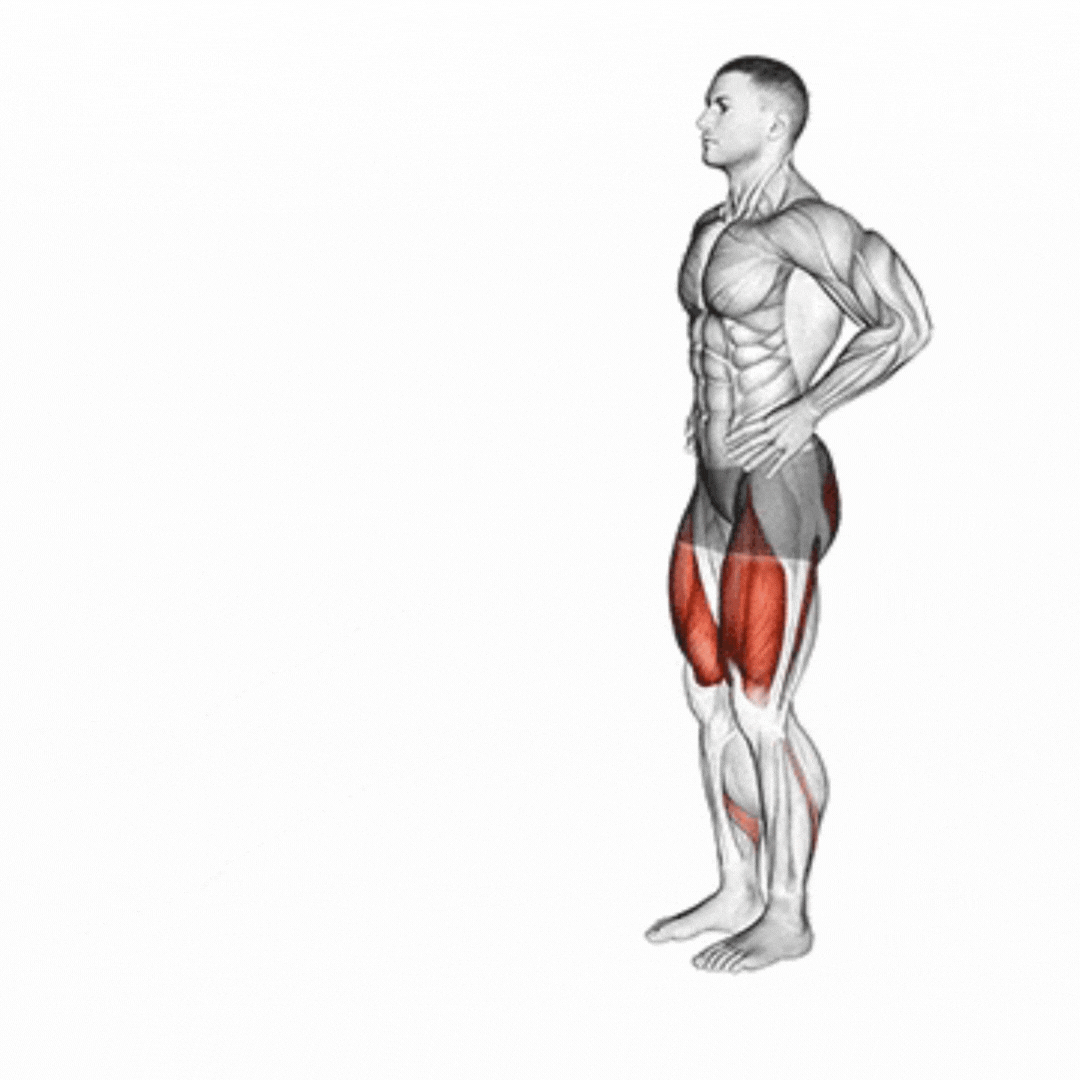
The Bodyweight Squat is a classic compound exercise that requires no equipment and represents one of the fundamental movement patterns of the lower body. Also known as the air squat, it works the quadriceps, gluteus maximus, and hamstring muscles together. It is ideal for beginners to learn squat form, and for experienced individuals as a warm-up or high-rep conditioning workout. Since it requires no equipment, it can be done anywhere; it is a practical choice for home, office, park, or travel environments. It also improves functional performance by strengthening the sit-to-stand mechanics, which is a fundamental movement of daily life. With its joint-friendly nature, it is safely used in rehabilitation processes. When done regularly, it provides significant improvement in leg strength, hip mobility, balance, and endurance.
Adım Adım Talimatlar
- 1
Stand with your feet shoulder-width apart, toes pointing slightly outward.
- 2
Extend your arms in front of you or cross them at chest level to maintain balance.
- 3
Keep your chest up, pull your shoulders back, and brace your core.
- 4
Lower yourself in a controlled manner by pushing your hips back and bending your knees.
- 5
Descend until your thighs are parallel to the floor, or as far as your flexibility allows.
- 6
Your knees should track in the same direction as your toes and not cave inward.
- 7
Push through your heels and squeeze your quadriceps and glutes to stand back up.
- 8
Fully extend your hips at the top position, but do not hyperextend.
- 9
Keep your back straight and chest up throughout the movement.
Önemli Noktalar
- ✓Feet shoulder-width apart, toes slightly outward.
- ✓The movement should initiate from the hips, not the knees.
- ✓Keep your back straight, chest up, and core engaged.
- ✓Knees must track in the same direction as your toes.
- ✓Push up through your heels, not your toes.
Yaygın Hatalar
- ✗Lifting heels off the floor - indicates insufficient ankle mobility.
- ✗Letting knees cave inward - creates joint stress.
- ✗Rounding the back - strains the lower back.
- ✗Inadequate range of motion - muscles are not fully engaged.
- ✗Leaning the torso too far forward - increases the risk of lower back injury.
- ✗Performing the movement too fast and without control - increases injury risk.
Nefes Kontrolü
Inhale and brace your core as you lower down, exhale as you stand back up.
Kas Aktivasyonu
Güvenlik
Dikkat Edilmesi Gerekenler
- Those with acute knee injuries should be cautious.
- Those with acute lower back pain should pay close attention to form control.
- Those with hip joint issues should limit their range of motion.
- Those with balance issues should perform it with support.
Güvenlik İpuçları
- Start with a partial range of motion first, then gradually go deeper.
- Check your form by looking in a mirror or working with a trainer.
- If ankle mobility is insufficient, you can use a heel wedge.
- Stop the exercise if you feel knee or lower back pain.
- Perform on a soft surface; avoid excessive reps on hard floors.
İlgili Egzersizler
Benzer kas grubunu çalıştıran egzersizler
Egzersiz Bilgisi
Ekipman
Birincil Kaslar
İkincil Kaslar
Faydalar
- ✓Teaches the squat movement pattern.
- ✓Develops the quadriceps and glutes at a foundational level.
- ✓Requires no equipment, can be done anywhere.
- ✓Suitable for rehabilitation due to its joint-friendly nature.
- ✓Strengthens functional sit-to-stand mechanics.
- ✓Supports cardiovascular health at high repetitions.
- ✓Improves hip mobility and flexibility.