.gif)
Açıklama
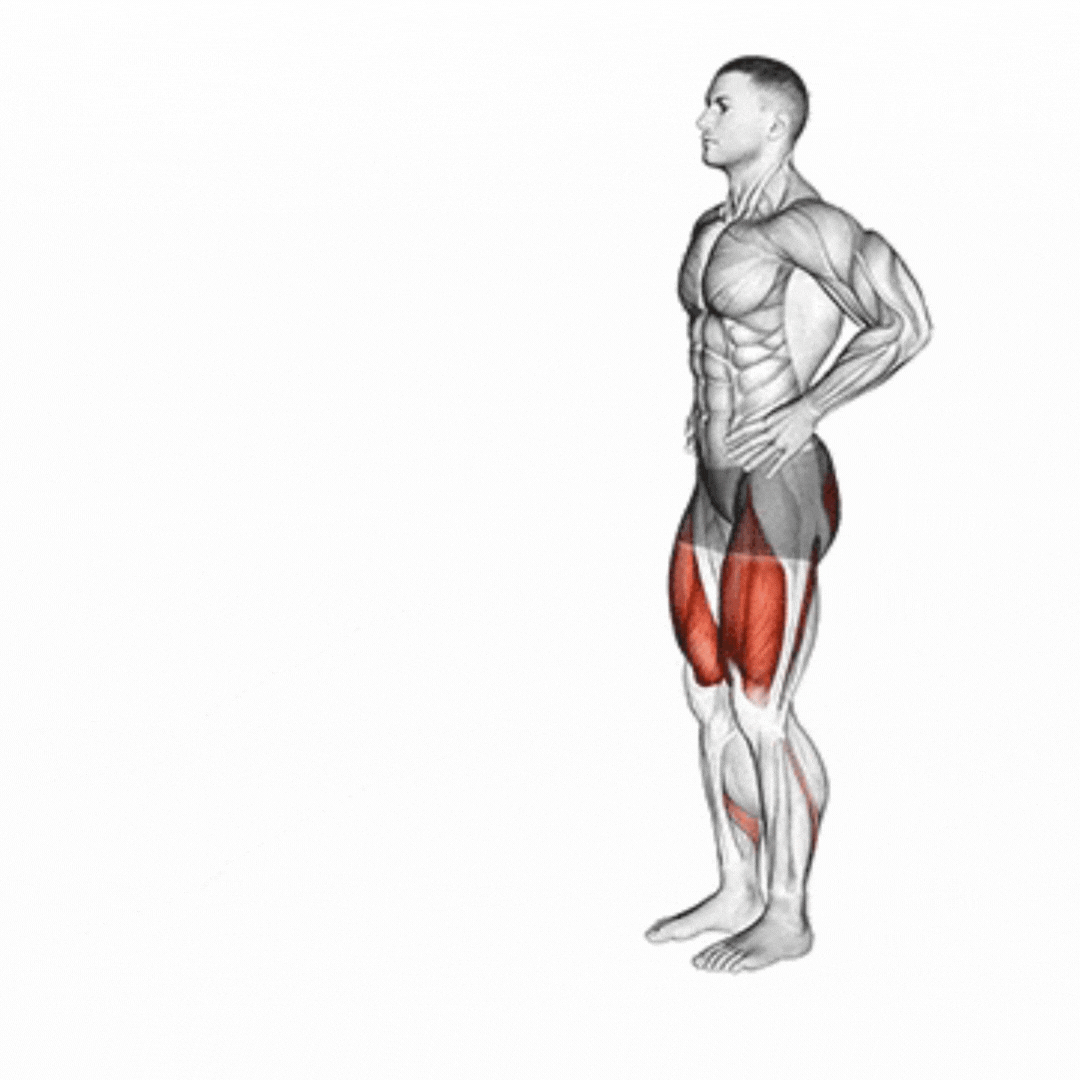
The Bodyweight Sissy Squat is a classic exercise performed by bending at the knees while leaning the body backward, providing maximum isolation for the quadriceps muscles. Despite its name, this is a highly challenging movement that involves a specific kinematic pattern where the knees extend forward and the torso leans back. This position stretches the rectus femoris and all fibers of the quadriceps, ensuring intense activation. Unlike other exercises in the squat family, the glutes and hamstrings are disengaged, placing maximum load on the quads. Since it requires no equipment, it is ideal for home workouts. It also demands balance, hip flexor flexibility, and knee stability. Used by professional bodybuilders to enhance quad definition, this movement, dating back to ancient Greece, is considered one of the most effective isolation exercises for anterior leg development.
Adım Adım Talimatlar
- 1
Stand with your feet slightly narrower than shoulder-width apart; hold onto a support point (bench, door handle) if necessary.
- 2
Slightly lift your heels off the floor, pressing through your toes and the balls of your feet.
- 3
Brace your core and keep your torso straight (neutral spine).
- 4
Lean your torso backward while driving your knees forward; your hip angle must remain fixed.
- 5
Your torso and thighs should form a straight line, bending only at the knees.
- 6
Lower yourself until you feel a deep stretch in your quadriceps.
- 7
If possible, continue lowering until your knees are close to the floor.
- 8
Squeeze your quadriceps to push back up to the starting position.
- 9
It is crucial not to push your hips back during the movement; your torso must remain upright.
Önemli Noktalar
- ✓The torso and thighs must be in a straight line; do not bend at the hips.
- ✓Heels should be slightly elevated; press through the balls of your feet for balance.
- ✓The movement should only occur at the knees, keeping the hips locked.
- ✓Keep your back neutral and straight; never round it.
- ✓Maintain balance by holding onto a support point if needed.
- ✓Lower yourself until you feel a strong stretch in the quadriceps.
Yaygın Hatalar
- ✗Pushing the hips back - turns the movement into a regular squat and ruins quadriceps isolation.
- ✗Keeping heels flat on the floor - strains the ankles and limits range of motion.
- ✗Dropping down too fast - places excessive stress on the knee joints.
- ✗Losing balance and falling backward - use a support if necessary.
- ✗Rounding the back - puts unnecessary strain on the spine.
- ✗Insufficient range of motion - prevents the quadriceps from being fully engaged.
Nefes Kontrolü
Inhale as you lower yourself, exhale as you rise back up and squeeze your quadriceps.
Kas Aktivasyonu
Güvenlik
Dikkat Edilmesi Gerekenler
- Individuals with acute knee injuries or chondromalacia should avoid this exercise.
- Those with a history of anterior cruciate ligament (ACL) injuries should proceed with caution.
- People with patellar tendon issues should avoid this movement.
- Individuals with lower back pain must pay strict attention to core control.
- Those with balance issues should perform the exercise with support.
Güvenlik İpuçları
- Start by performing the exercise with support (wall, bench).
- Perform the movement on a soft mat.
- Use a slow and controlled tempo.
- Limit your range of motion if you experience any knee pain.
- Begin with a partial range of motion and increase it gradually.
- Place a block or wedge under your heels for ankle comfort.
İlgili Egzersizler
Benzer kas grubunu çalıştıran egzersizler
Egzersiz Bilgisi
Ekipman
Birincil Kaslar
İkincil Kaslar
Faydalar
- ✓Maximally activates the quadriceps in an isolated manner.
- ✓Intensely targets the rectus femoris muscle.
- ✓Enhances quadriceps definition and the teardrop muscle (vastus medialis).
- ✓Requires no equipment, making it easy to do at home.
- ✓Strengthens the muscles around the knee (when performed correctly).
- ✓Improves balance and core stabilization.
- ✓Increases hip flexor flexibility.